Table of Contents
- Introduction
- Why Financing Matters for Commercial Solar
- Understanding the Three Main Financing Options
- What Is a Power Purchase Agreement (PPA)?
- Pros and Cons of PPAs for Businesses
- What Is a Solar Lease?
- Pros and Cons of Solar Leases for Businesses
- What Is Direct Ownership (Cash Purchase or Loan)?
- Pros and Cons of Direct Ownership
- PPA vs Lease vs Ownership: Quick Comparison Table
- Factors to Consider When Choosing a Financing Option
- How Incentives and Tax Credits Impact Each Financing Method
- Real-World Case Studies: Financing Solar the Right Way
- Future Trends in Commercial Solar Financing
- Conclusion
- FAQs
Introduction
Commercial solar energy adoption is booming across the United States in 2025.
However, while solar panels are more affordable than ever, financing the project properly is critical to maximize return on investment (ROI) and business sustainability goals.
Choosing between a Power Purchase Agreement (PPA), solar lease, or direct ownership can dramatically affect your bottom line over the next 20–30 years.
This guide dives deep into commercial solar financing options, providing a clear, honest comparison to help you make the best decision for your business.
Why Financing Matters for Commercial Solar
Solar systems represent a significant upfront investment — but the financing structure determines:
- Who owns the system
- Who claims tax incentives
- How much you save monthly
- How quickly you break even
- Your ongoing maintenance responsibilities
Getting this decision right can mean the difference between tens of thousands (or even millions) in lost savings or maximizing your competitive advantage.
Understanding the Three Main Financing Options
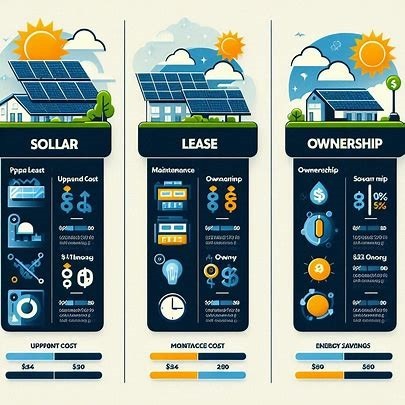
| Financing Option | Ownership | Upfront Cost | Maintenance | Incentives |
| PPA | Third-party | $0 | Third-party handles it | Claimed by provider |
| Lease | Third-party | $0 | Provider handles maintenance | Claimed by provider |
| Ownership | Business owns | Full cost (or loan) | Business responsibility | Business claims incentives |
What Is a Power Purchase Agreement (PPA)?
A Power Purchase Agreement (PPA) is a financial arrangement where a third-party developer:
- Installs, owns, and maintains the solar system on your property.
- You agree to buy the electricity generated at a fixed per-kWh rate, typically lower than your utility rate.
- Typical terms are 15–25 years.
Key Point:
With a PPA, you pay for the energy, not the solar system itself.
Pros and Cons of PPAs for Businesses
Pros
- $0 upfront capital required
Ideal for businesses wanting solar benefits without a major investment. - Predictable energy costs
Often 10–30% lower than utility rates, with predictable escalators. - No maintenance worries
The PPA provider handles all repairs and performance guarantees. - Energy savings from Day 1
Immediate reduction in electricity bills.
Cons
- No ownership of system
You don’t build asset value on your balance sheet. - Limited control
Provider decides system specifications, upgrades, and operations. - Potential restrictions on property sale
Future buyers must assume or renegotiate the PPA contract. - No tax benefits for your business
The PPA provider claims the federal Investment Tax Credit (ITC) and depreciation.
What Is a Solar Lease?
A solar lease is very similar to a PPA, but instead of paying for energy, you pay a fixed monthly “rent” for using the solar system.
- You don’t own the system.
- Monthly payments are based on the system size, not energy production.
- Lease terms are typically 15–25 years.
Key Point:
With a lease, you pay for system access — not per kWh.
Pros and Cons of Solar Leases for Businesses
Pros
- $0 down solar
No capital investment needed. - Predictable monthly cost
Helps budgeting and cash flow forecasting. - System performance guaranteed
Provider must ensure it meets minimum production thresholds. - Avoids long-term energy market risk
Locked-in lease payment vs fluctuating electricity prices.
Cons
- No ownership or asset creation
At the end of the lease, you must renew, buy, or remove the system. - Possibility of overpaying
If electricity rates fall (unlikely, but possible), you might overpay. - Less flexibility
Harder to make system changes or expansions. - No access to tax credits
Again, the leasing company claims the federal incentives.
What Is Direct Ownership (Cash Purchase or Loan)?
With direct ownership, your business either:
- Pays cash for the solar project upfront, or
- Finances it with a commercial loan or energy loan.
You own the system 100% — and you:
- Claim all financial incentives (ITC, MACRS depreciation).
- Reap all energy savings.
- Handle maintenance (or contract it out).
Key Point:
Ownership = Maximum long-term savings + Tax advantages.
Pros and Cons of Direct Ownership
Pros
- Highest lifetime ROI
Typical internal rates of return (IRR) between 12–20%. - Immediate tax benefits
Claim 30% Investment Tax Credit and 5-year accelerated depreciation. - Asset value increase
Boosts commercial property value. - Full control
Decide system design, maintenance, and upgrades. - Energy independence
Greater protection from rising utility rates.
Cons
- High upfront costs
Typical commercial solar systems range from $1 million to $5 million+ depending on size. - Ongoing responsibility
You manage maintenance, repairs, and performance. - Longer payback period
Typical breakeven is 5–8 years — though accelerated by incentives.
PPA vs Lease vs Ownership: Quick Comparison Table
| Feature | PPA | Lease | Ownership |
| Upfront Cost | $0 | $0 | High |
| Ownership | No | No | Yes |
| Monthly Payment Type | Per kWh | Fixed Lease Payment | Loan or none (after payback) |
| Energy Savings | Moderate | Moderate | Highest |
| Maintenance | Provider | Provider | Owner responsibility |
| Tax Benefits | No | No | Yes |
| Control | Low | Low | Full |
Factors to Consider When Choosing a Financing Option
When selecting the best commercial solar financing strategy, consider:
- Your Business Cash Flow
- Cash reserves? Capital priorities?
- Will a loan or cash purchase strain operations?
- Long-Term Business Plans
- Planning to sell the property within 5–10 years?
- A lease or PPA might complicate transfer.
- Desire for Ownership
- Do you value control and maximum ROI?
- Or prefer a “hands-off” third-party approach?
- Risk Tolerance
- Can you handle solar performance risks (cloudy years, maintenance)?
- Or would you rather offload those risks?
- Eligibility for Incentives
- Nonprofits can’t claim ITC — making PPAs or leases better.
- Taxable entities with strong tax appetite should strongly consider ownership.
To learn more about our services and solutions, visit Energy America for detailed insights.
How Incentives and Tax Credits Impact Each Financing Method
| Incentive | PPA | Lease | Ownership |
| 30% Federal ITC | Provider claims | Provider claims | Business claims |
| MACRS Depreciation | Provider claims | Provider claims | Business claims |
| State Rebates | Provider claims (pass through possible) | Provider claims (pass through possible) | Business claims |
| Net Metering | Typically passed to client | Typically passed to client | Full benefit to client |
Important:
Some PPA and lease providers share a portion of the incentives through reduced pricing, but you don’t directly control or maximize them.

Real-World Case Studies: Financing Solar the Right Way
1. Retail Chain (Ownership Model)
- Location: Texas
- System Size: 500 kW
- Financing: $1.1M loan at 5.2% interest
- Results:
- Payback in 6.3 years
- ROI over 20 years: 18%
- Claimed full ITC and bonus depreciation
2. Manufacturing Facility (PPA Model)
- Location: California
- System Size: 1 MW
- Financing: 20-year PPA at $0.075/kWh
- Results:
- 23% savings vs grid prices
- No maintenance obligations
- Project completed without impacting capital budget
3. Office Building (Lease Model)
- Location: New York
- System Size: 250 kW
- Financing: Fixed 20-year lease
- Results:
- $2,500 monthly lease payment
- $3,600/month average electricity offset
- Immediate positive cash flow
Future Trends in Commercial Solar Financing
- Solar-as-a-Service models growing
No ownership, no maintenance — just energy bill savings. - Green Bonds for Solar Projects
Businesses issue bonds directly to fund large solar systems. - More PPA Aggregators
Multiple small businesses combining into shared PPAs for better terms. - Blockchain Smart Contracts
Transparent, real-time monitoring and payment settlements. - Energy Storage Integration
More PPAs and leases now include batteries to boost resilience.
Conclusion
Choosing between a PPA, lease, or ownership for your commercial solar project depends heavily on your:
- Financial goals
- Business structure
- Appetite for tax benefits
- Willingness to manage the system
Ownership offers the highest lifetime ROI but demands upfront capital and management.
PPAs and leases offer immediate savings with zero upfront cost, but you sacrifice control and incentives.
There’s no universal “right” choice — but armed with this knowledge, you can confidently craft a financing strategy that matches your organization’s energy and financial future.
FAQs
Q1: Can I switch from a PPA to ownership later?
A1: Yes, many PPAs offer a buyout option after 5–7 years.
Q2: What happens at the end of a solar lease?
A2: You can often renew the lease, buy the system at fair market value, or have it removed.
Q3: Is a solar loan considered “off-balance sheet” financing?
A3: No — loans impact your balance sheet. PPAs and leases often qualify as off-balance-sheet.
Q4: Does a solar PPA require a lien on my property?
A4: Sometimes — depending on the financing provider — always review contract terms carefully.
Q5: Are solar financing options different for nonprofits?
A5: Yes. Nonprofits usually favor PPAs because they can’t claim tax credits themselves.